
The B2B buying journey has fundamentally broken away from the old software playbooks. If your go-to-market strategy still treats lead generation like a numbers game—pouring raw traffic into the top of a funnel and praying for sales-ready leads at the bottom—you are likely burning cash.
Modern buyers do not need sales reps to educate them. They have already done their homework on dark social, read peer reviews, and consulted their networks long before your SDR spikes their inbox. Data shows up to 85% of B2B buyers purchase from a vendor they already had on their “day one list.” Even worse, buyers spend only about 17% of their total journey meeting with potential suppliers—a tiny window divided among every competitor on their radar.
Yet, many marketing teams still celebrate surges in form fills and eBook downloads while sales reps stare at a stagnant pipeline. The issue isn’t activity, budget, or tools. It’s architectural. Most organizations fail because they cannot define, capture, and hand off a truly sales-ready lead.
The Statistical Reality: A Tale of Two Pipelines
In 2026, lead generation consumes an average of 37% of total marketing budgets. The global industry is on track to hit $295 billion by 2027, growing at a 17% compound annual growth rate (CAGR). But look under the hood, and you’ll see a massive performance gap between average teams and top performers.
While the median conversion rate from Marketing Qualified Lead (MQL) to Sales Qualified Lead (SQL) stagnates at 13%, top-quartile teams are converting 28%. This divergence comes down to execution: elite teams have aggressively adopted AI for predictive scoring, intent enrichment (47%), and dynamic nurture sequencing (38%).
Meanwhile, channel dynamics are shifting. Email and LinkedIn remain dominant—with LinkedIn holding a near-monopoly, adopted by 97% of B2B marketers and driving 80% of social leads. Outbound cold calling has dropped by 7.51% as executives block unsolicited noise. Paid search still drives 22% of volume, but its share is shrinking as budgets pivot toward Account-Based Marketing (ABM) and partner-led channels.
The baseline reality remains brutal: 79% of marketing leads never convert to sales.
The Four Catalysts for Failure
When lead generation engines stall, the root causes look identical across SaaS, healthcare, and manufacturing.
1. The Illusion of Scale and “Tool-First” Blunders
The quickest way to kill an outbound motion is scaling before you earn the right to. Teams buy sequencing tools, automated scrapers, and AI copywriters before manually validating who actually buys, what triggers the purchase, and what messaging resonates. Automation doesn’t fix a broken strategy; it just distributes your irrelevance at lightning speed. Mass-blasting generic scripts won’t just fail to book meetings—it will ruin your domain sending authority before you launch a viable campaign.
2. The Ideal Customer Profile (ICP) Delusion
Targeting “mid-market SaaS companies with 200 to 1,000 employees” isn’t an ICP; it’s a superficial filter. High-converting frameworks require technographics (their software stack), explicit decision-making hierarchies, and organizational triggers. Triggers are the catalyst for timing. You need to look for leadership changes (a new RevOps head), tech shifts (a CRM migration), or growth signals (regional expansion). Without a clear trigger, your outreach relies entirely on luck.
3. The Single-Threaded Trap
The average complex B2B purchase involves six to thirteen stakeholders. Yet, most campaigns focus on a single senior executive. If that contact changes jobs, loses budget authority, or goes on leave, the deal vanishes. Multi-threaded campaigns that engage the economic buyer, technical evaluator, and end-user simultaneously see conversion rates between 8% and 15%, compared to the 2% industry average for single-threaded outreach.
4. Sales and Marketing Misalignment
According to Forrester, misalignment on lead quality is the primary reason teams miss pipeline targets. Marketing labels a lead “qualified” because someone downloaded an eBook. Sales defines a qualified lead by budget, active evaluation, and immediate timeline. Without a documented, jointly-owned Service Level Agreement (SLA), every handoff is an argument. When sales reps stop trusting marketing pipeline, they stop working the leads entirely.
Defining the Sales-Ready Lead
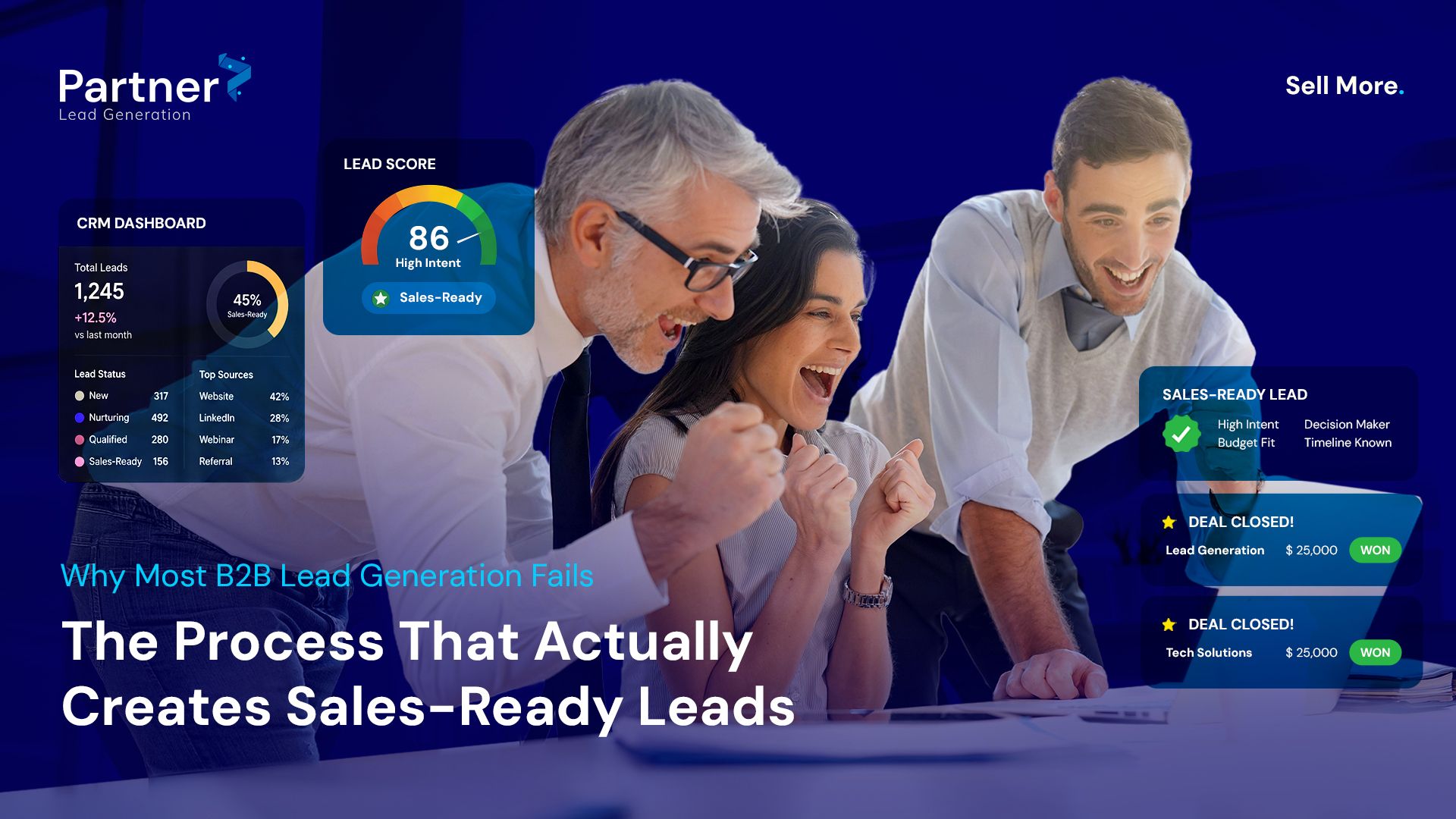
To fix the handoff, you need an objective qualification framework. A sales-ready lead is not a contact who consumed educational content. It is an account whose firmographic fit, behavioral actions, and commercial intent indicate a high probability of closing.
To move prospects through these stages cleanly, teams rely on qualification frameworks like BANT (Budget, Authority, Need, Timing) for baseline deals, or MEDDIC for complex enterprise cycles where mapping metrics, economic buyers, and internal champions is mandatory.
The real differentiator, however, is layering intent data. First-party intent tracks actions on your own properties (e.g., viewing your pricing page three times in a week). Third-party intent tracks surges across the broader web (e.g., an account researching specific keyword topics or competitor reviews on G2). Intercepting accounts during these active search spikes prevents you from playing catch-up.
Partner Lead Generation: The Ultimate Accelerator
Direct inbound and outbound lines are necessary, but partner ecosystems are often your most efficient, high-trust pipeline builders. Referred leads from trusted partners consistently yield a 30% higher conversion rate and a 16% higher lifetime value.
A modern partner ecosystem maps out across four distinct vectors:
- Technology Partners (ISVs): Independent vendors whose tech integrates with yours. Pipeline is driven via co-branded marketing, joint webinars, and app store marketplaces.
- Service Partners & System Integrators (SIs): Consultants and agencies acting as trusted advisors. They position your platform as part of a broader digital transformation. For instance, enterprise SIs in key hubs like California require tailored, practice-level engines targeting accounts undergoing massive cloud migrations.
- Resellers & Distributors: Externalized sales forces buying wholesale and selling to their established customer footprints.
- Internal & Affiliate Referral Engines: Programs that turn broader networks into pipeline. Even non-corporate entities use this; the United States Postal Service (USPS) generated over $835 million in new revenue through its internal “Submit-a-Lead” employee program.
Managing this requires robust Partner Lead Management (PLM) to automate routing and prevent channel conflict. A strict Deal Registration system is non-negotiable here. If a partner registers an enterprise account, they must receive clear windows of exclusivity (typically 60 to 90 days) to prevent internal direct sales reps from poaching the deal and destroying ecosystem trust.
High-Intent B2B SEO and the AI Shift
Inbound demand generation lives and dies by search visibility, but traditional B2B SEO is fundamentally changing.
The old playbook of chasing high-volume, broad keywords like “CRM software” is dead. These terms pull informational traffic—students, researchers, and entry-level employees. Worse, the rise of Generative AI search architectures (like Google’s AI Overviews) has created a “Zero-Click” environment. If an AI engine can summarize your basic informational article directly on the search results page, the user never clicks through to your site.
To win pipeline today, you must optimize for a high Commercial Value Score, targeting low-volume, high-intent long-tail keywords that signal evaluation:
- Transactionality Modifiers: Terms like “software,” “platform,” “vendor,” or “services” paired with your niche.
- Motivation Modifiers: Queries featuring “pricing,” “ROI,” “vs,” or “alternatives.”
Content must also pass the test of Answer Engine Optimization (AEO). AI models look for clear structure and undeniable expertise (E-E-A-T). By formatting direct, concise answers at the start of your high-intent pages, you turn your content into “snippet bait” that models like ChatGPT and Gemini cite as their definitive source. This strategy must sit on a flawless technical foundation: rapid page speeds, clean Schema markup, and perfect mobile responsiveness.
The Execution Ecosystem: When to Outsource
When internal pipelines lag, building an in-house SDR team from scratch can take months of hiring and ramp-up time. Because of this complexity, many organizations leverage specialized demand generation agencies to compress their time-to-market.
The agency space has evolved past basic list brokering. Elite firms build their value on technical execution and hybrid frameworks:
- Human + AI Synergy: Top agencies deploy AI agents to handle top-of-funnel verification and transactional messaging, freeing up experienced human SDRs to manage complex, consultative sales conversations.
- Intent Scoring: Modern agencies use advanced predictive scoring architectures to filter out the noise, ensuring your internal sales reps only spend time on accounts with verified, active commercial intent.
- Managed Pipeline Services: Providers can manage the entire stack—from defining the ICP and scraping clean compliance-certified lists to placing confirmed discovery meetings directly onto an executive’s calendar.
Metrics That Matter: Moving to Pipeline Velocity
If you measure your marketing team solely on total MQL volume or the lowest possible Cost Per Lead (CPL), you are incentivizing them to pass low-quality names to your sales team. To optimize for actual revenue, shift your telemetry to pipeline health metrics.
- MQL to SQL Conversion Rate: Measures alignment between marketing targets and actual sales requirements.
- Cost Per Pipeline (CPP): Total marketing and outbound spend divided by the number of sales-ready opportunities created.
- Pipeline Velocity: The speed at which an account moves from initial capture to closed-won revenue, exposing internal operational friction.
- Win Rate by Channel Origin: Isolates performance data so you can double down on high-value channels (like SEO or partner-led) that actually close, even if their initial top-of-funnel cost looks higher on paper.
True scale requires a closed-loop attribution setup. When a sales rep disqualifies a lead in the CRM, that data must instantly feed back to marketing with explicit reason codes (“Wrong Persona,” “No Budget”). This feedback loop allows marketing algorithms to optimize ad spend, adjust keyword strategies, and refine outbound parameters in real-time.
Dominating your sector isn’t about shouting the loudest or purchasing the most software. The companies winning the market are those that treat lead generation as a unified revenue architecture—combining data precision, channel diversity, and tight operational alignment to capture the right buyer at the exact moment they are ready to purchase.
Stop Chasing Ghosts. Start Closing Signals.
The market got quieter. Buyers didn’t disappear, they changed how they buy. While others spray volume and hope, winners move on timing, intent, and precision.
At Partner Lead Generation, we build signal-driven growth engines that help you find the right buyers before your competitors do.