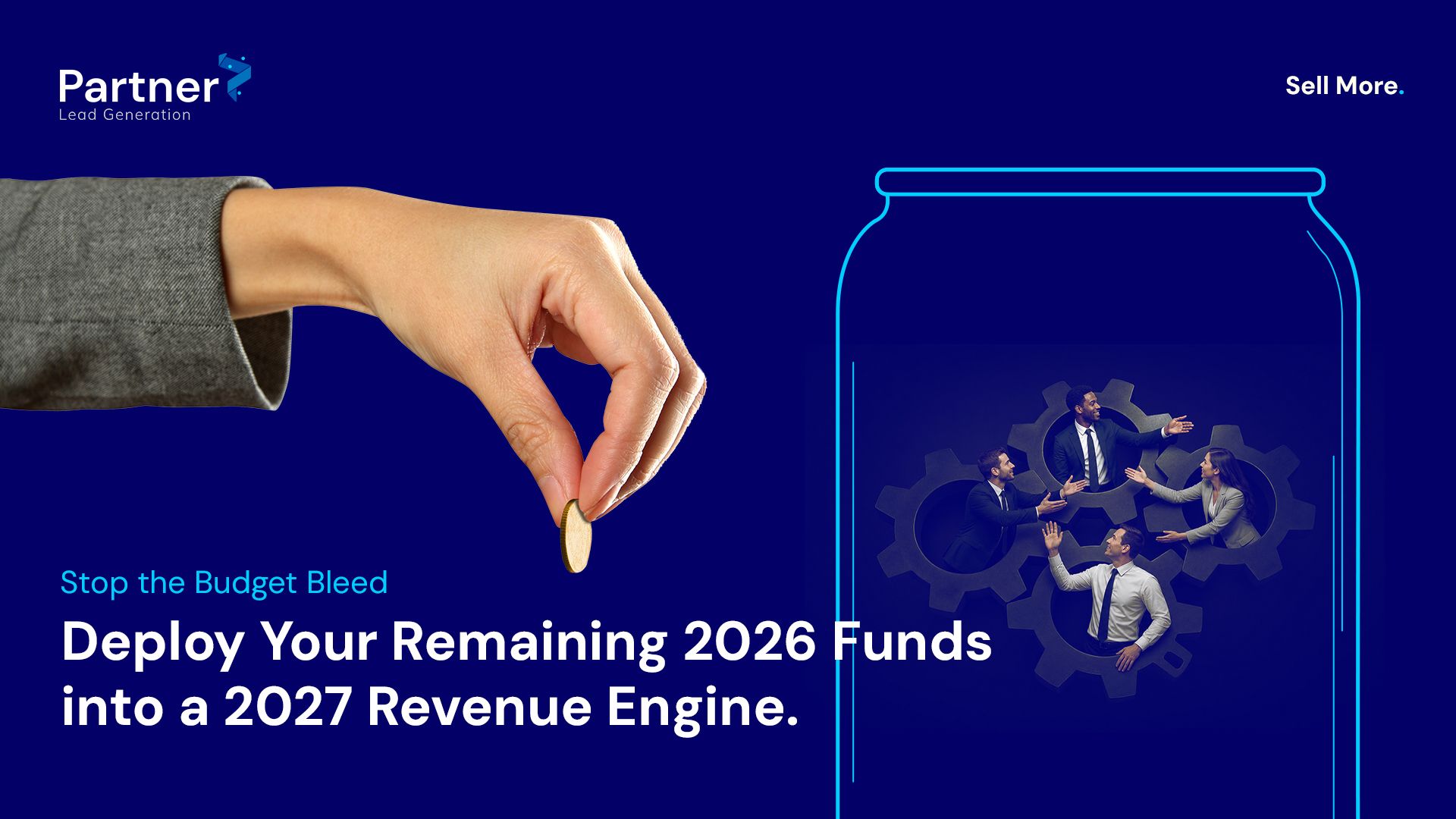
As we stare down the final quarter of 2026, B2B revenue leaders are facing a familiar, frustrating paradox. You have a surplus budget, and the clock is ticking to transform those expiring temporary dollars into a high-yielding 2027 revenue engine. Driven by the fear that unspent funds will result in slashed allocations for the upcoming fiscal year, marketing departments routinely engage in a frantic “use-it-or-lose-it” capital flush.
Federal and corporate analyses show that fourth-quarter spending suddenly spikes by an average of 25.4%. But let’s be candid about where that money actually goes. It usually gets funneled into disconnected ad blitzes, redundant tech purchases, or massive databases of cold contacts.
Industry data tells us that 80% of mid-market B2B companies are making a multimillion-dollar mistake right now. They are confusing mere end-of-year activity with strategic revenue generation. It is time to abandon the late-stage, bottom-of-funnel ad blitz and redirect that expiring capital into a sustainable, ecosystem-led revenue engine for 2027.
The “Use-It-Or-Lose-It” Trap
When marketing teams realize they have cash burning a hole in their pocket in November, the default reaction is the “spray and pray” deployment. This capital destruction usually takes three forms:
- MarTech Stack Bloat: Gartner’s 2025 survey revealed that teams only use about 49% of their existing capabilities. Buying more software in Q4 just to exhaust funds creates technical debt, not pipeline.
- Paid Media Waste: Q4 is brutally expensive. Ad auctions are flooded by retail brands, pushing B2B costs per click up by 20% to 35%. Pumping budget into these hyper-inflated auctions crushes your return on ad spend.
- Untracked Outbound Data: Buying massive lead lists to force your SDRs into cold-calling prospects with zero intent is a massive opportunity cost.
The average enterprise B2B sales cycle now spans anywhere from 121 to 218 days. The math is undeniable: any top-of-funnel demand you generate in November 2026 isn’t going to close until midway through 2027. Therefore, you must treat your Q4 budget as an early-stage infrastructure investment, not a magical fix for this year’s quota.
Why the Old Playbook is Broken
To understand why the traditional budget flush fails, we have to look at the macro realities of 2026. Customer acquisition costs (CAC) have skyrocketed 60% over the last five years. At the same time, the typical B2B buying committee has expanded to 11.2 independent stakeholders for deals over $50,000.
Attempting to persuade over a dozen unique personas via direct paid advertising requires exorbitant spending. Compare the baseline acquisition costs across the industry:
| Acquisition Channel | Average B2B CAC | Trend & Insight |
| Partner / Referral | $150 | Lowest CAC. Leverages transferred trust and warm introductions. |
| Inbound Marketing | $200 | Cost-effective but requires long-term organic compounding. |
| Overall, Blended Avg. | $300 | The baseline metric across B2B categories in 2026. |
| Paid Advertising | $350 | Highly sensitive to inflation. CPCs are rising consistently. |
| Outbound Sales | $400 | SDR-driven models face declining connection rates. |
Compounding this CAC crisis is the explosion of Generative AI. Hyper-automation has flooded the market with synthesized content, causing intense buyer fatigue. As a result, B2B buyers are retreating to a “flight to trust.” They are seeking human expertise, third-party validation, and channel partners to cut through the AI noise.
The Ecosystem Advantage: Partner-Led Growth
In a landscape defined by high costs and AI-induced skepticism, partner lead generation is mathematically superior to direct sales. Instead of carrying the entire financial burden of audience building, you leverage the established credibility of non-competing businesses that share your Ideal Customer Profile.
The financial benefits of partner-led growth hit three critical metrics:
- Deal Velocity: Deals influenced by partners close 46% faster than direct-only transactions.
- Win Rates: Partner-attributed deals boast a 53% improvement in win rates.
- Average Contract Value (ACV): Partner-involved deals are consistently 32% to 40% larger because partners often bundle solutions into broader transformations.
4 Ways to Deploy Q4 Cash Right Now
Stop funding inefficient direct ads. To build a predictable pipeline for next year, shift your Q4 spending from short-term operational expenses to long-term capital investments. Here is how to strategically deploy those remaining funds today.
1. Outsource Channel Partner Acquisition
Your internal sales team likely lacks the bandwidth to recruit strategic partners. The fastest way to deploy Q4 funds is to hire specialized B2B lead generation agencies that focus strictly on channel recruitment. Agencies like Launch Leads or Belkins can secure guaranteed meeting volume with VPs of Partnerships. Pre-paying these retainers in Q4 secures guaranteed pipeline momentum for January.
2. Upgrade Your Partner-Friendly Content
A massive bottleneck in channel growth is a lack of enablement material. Stop handing your partners generic PDFs and expecting them to sell. Use your budget to hire content agencies to build “Hero” assets—like industry benchmark reports or co-branded webinar series. Fund the event software, pay the speaker fees, and cover the promotional ad spend. By removing the financial friction for your partners, you guarantee shared lead lists.
3. Implement Partner Relationship Management (PRM) Tech
Managing lead routing and attribution on spreadsheets is a recipe for disaster. Allocate your budget flush toward implementing robust PRM platforms (like xAmplify or HubSpot’s partner integrations). Buying the licenses and paying implementation consultants in Q4 ensures you have a zero-conflict lead registration system up and running before the new year kicks off.
4. Structure Strategic Market Development Funds (MDF)
Historically, MDF programs act as discretionary slush funds with terrible utilization. Fix this by offering “campaigns in a box.” Pre-fund a highly targeted direct mail initiative for your partners. Physical assets delivered to executive decision-makers yield up to 5x higher response rates in account-based marketing. Your partner supplies the target list, and you execute the campaign using Q4 reserves.
Defending the Investment
To protect this strategic pivot, you must abandon broken legacy analytics. Last-click attribution models falsely assign all the glory to paid search, ignoring the partner touchpoints that actually generated the trust. Transitioning to Multi-Touch Attribution (MTA) connected to your CRM allows you to track fractional credit across the entire 121-day sales cycle.
Furthermore, adopting a Zero-Based Budgeting (ZBB) framework—where every dollar must be justified from scratch annually—proves that partner lead generation consistently wins over direct ads due to its lower CAC and higher lifetime value.
The mathematics of 2027 are crystal clear: ecosystem-led growth will dominate. Stop bleeding your hard-earned capital into the void of saturated, overpriced ad auctions. Deploy those funds right now to build the partnerships, infrastructure, and trust that will systematically drive your revenue engine into the future.
Stop Chasing Ghosts. Start Closing Signals.
The market got quieter. Buyers didn’t disappear, they changed how they buy. While others spray volume and hope, winners move on timing, intent, and precision.
At Partner Lead Generation, we build signal-driven growth engines that help you find the right buyers before your competitors do.